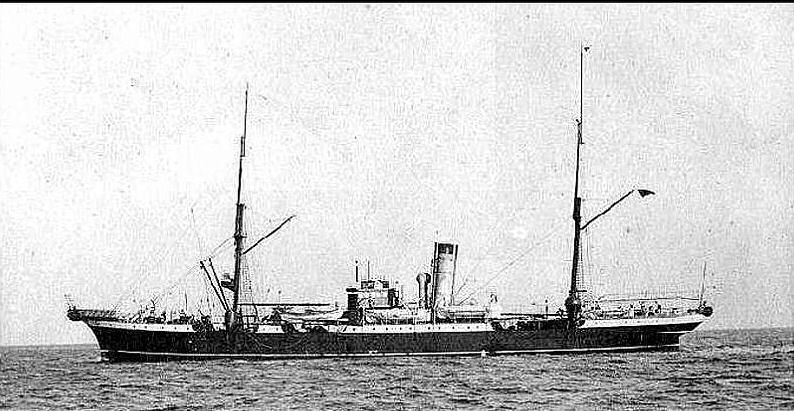
Relationship to Titanic disaster / inquiries.
Chartered by the White Star Line to cruise the area of Titanic's sinking site and search for missing bodies. (Several sailors of the HMCS Niobe were assigned to Mackay-Bennett to augment the crew and assist with the body recoveries.) Left Halifax Wednesday, April 17 at 12:35 p.m. Returned to Halifax Tuesday, April 30 and moored at the Navy Dock No. 4 at about 9:30 a.m.
During the cruise, 306 bodies were recovered: 116 were buried at sea with Canon Kenneth O. Hind of Halifax's All Saints Cathedral officiating. The remaining 190 bodies were brought back to Halifax.
Data:
September 18, 1884
Launched.
October 21, 1884
Sea trials.
Based at Halifax, Nova Scotia
September - October 1899
On-board wireless apparatus installed by Marconi himself to cover the October America's Cup
yacht race off Sandy Hook at the mouth of New York Harbor.
1905
Assisted in laying the Commercial Cable Company's cable from Nova Scotia to New York.
Thereafter, much service devoted to maintaining this cable.
April 1912
The first of three vessels chartered by the White Star Line to recover bodies from the Titanic disaster.*
1922
Taken out of service. Used as a cable storage hulk at Plymouth, England.
1941
Sunk by German aircraft during a bombing of Plymouth. Refloated.
1965
Towed to Ghent, Belgium, for scrapping.
Spelling per 1911-1912 Lloyd's Register of Shipping.
* During the cruise to recover bodies of Titanic `s victims, members of Mackay-Bennett crew were paid double wages. On June 17, 1912, a check for US$2,500 was sent by Vincent Astor to the company for distribution among the crew; distributed proportionately by rank, the money amounted to about a month wages for each man. In addition, Captain Frederick H. Larnder was presented with a gold watch by the Astor family.
|